Ethiopia
GONDAR-FASIL GHEBBI
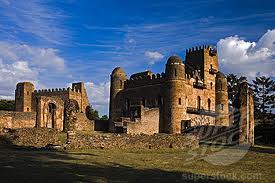
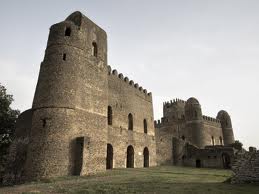
In the sixtenth and seventeenth centuries,the fortres city of Gondar-the Royal Enclosure-served as the residence of the Ethiopian emperor,Fasilides,who moved hiscapital here in 1636 AD. By the late 1640s he had built a great castle here,the recently restored Fasilades Palace.With its huge towers and looming battlement walls,it seems as if a piece of medieval Europe has been transported to Ethiopia.
Recognised as a UNESCO World Heritage site in 1979,the palace,surrunded by an impressive 900-m (2,953-ft) wall,stands in a compound filled with juniper and wildolive trees,amid Enqulal Gemb,or Egg Castle,named after its domed roof,the royal archive,many impressive churches and monastaries and a stable.These exemplify architecture that is marked by both Hindu and Arad influences,subsequently transformed by the Baroque style that the Jesuit missionaries brought to Gondar,and have earned the city the nickname "The Ethiopian Camelot".
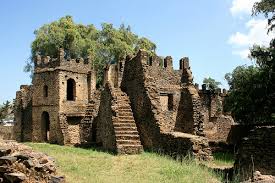
Beyond the the city to the north-west,by the Qaha River,are the Fasilades Baths.A two-storeyed,rustic battlement sits on the steps leading to a rectangular pool,while the bathing pavilion stands on pier arches and contains several rooms that may be reached via a stone bridge,partof wich could be raised for dedefence in times of battle. 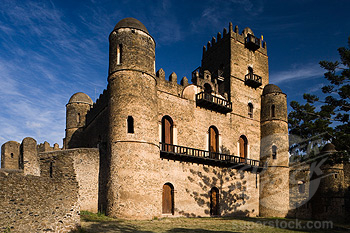
WHEN TO GO:September,October and November are the best time to visit
HOW TO GET THERE:Gondar lies on the historical route in north-west Ethiopia,north of Lake Tana.
WHAT IS THERE TO SEE:The ancient capital of Ethiopia.
CHURCHES AT LALIBELA
Lalibela is Ethiopia`s equivalent of Petra in Jordan.Surrounded on all sides by rugged and forbidding mountains to the north of the modern province of Wollo,Lalibela gives the impression that you`ve landed in a kingdom centuries past.The 11 medieval,monolithic churches of this thirtheenth-century "New Jerusalem"are Ethiopia`s top attraction,and they inspire awe,regardless of wether you are interested in religion or religious architecture.Perched at 2,630m,the monastic settlement of Lalibela is a desolate,isolated place,a centre of pilgrimage to its many annual visitors.
Located in the heart of Ethiopia near a traditional village with circular dwellings,the churches of Lalibela are cut straight from bedrock so their roof are at groound level.All 11 churches where build within a century-according to legend,with the help of angels.
Close examinations is required to appreciate the full extent of this achievement as some lie almost completely hidden in deep trenches,while others stand in open quarried caves.A complex labyrinth of tunnels and narrow passageways with offset crypts,grottoes and galleries connects them all.It`s a damp and silent subterranean world,apart from the echoing sounds of the chanting faithful,that needs to be experienced to be fully understood.
Once the thriving and populous capital city of a medieval dynasty,the passing centuries have reduced Lalibela to a village.The churches have been kept alive by generations of priests who guard their treasures of ornamented crosses,illuminated Bibles and illustraded manuscripts.From the road below,it remains nearly invisible against a horizon dominated by the 4,200m peak of Mount Abuna Joseph. 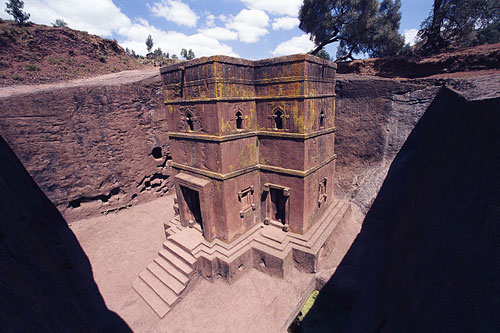
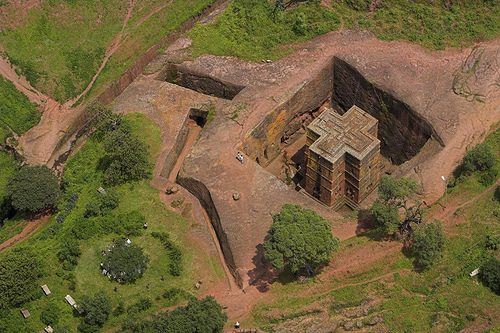
WHAT THERE TO SEE: 11 monolithic churches built in the thirtheenth century
WHEN SHOULD I VISIT: September,Octomber and November are the best time to visit
WHERE IS IT:In the former province of Wollo
WHY IS IT IMPORTANT: It is one modern Ethiopia`s holiest cities
AKSUM-RUINS OF ANCIENT CITY
Aksum is considered the holiest city of Ethiopia.Christianity was declared the national religion here in the fourth century by the ruler,Ezana,who constructed much of the monumental architecture and converted much of the Axumite Kingdom`s population to Christianity around 330 AD after his own conversion.Once a prosperous kingdom on the Tigray Plateau,it was close to the Blue Nile basin and the Afar depression and accessible to the port of Adulis on the Red Sea coast,wich allowed it to maintain trade relations with many nations including Egypt,India,the Sudan and Arabia.
At its peak,Akum controlled territories as far as southern Egypt,east to the Gulf of Aden,south to the Omo River and west to the Cushite Kingdom of Meroe.The South Arabian kingdom of the Himyarites was also under its power.
The modern city of Aksum is located in the north-estern portion of what is now Ethiopia,on the horn of Africa.It lies high on a plateu 2,195m (7,200ft) above sea level.According to the Ethiopian Orthodox Church,Aksum is where the original Ark of the Convent,containing the Ten Commandments,is located.The Ark is supposed to be in the seventeenth-century church of Our Lady Mary of Zion,but only its guardian may look at it.The church`s museum has a small but impressive collection of bibles,crosses and crowns.
Just past the museum is Aksum`s ancient stelae field.These are enormous carved pillars made from single granite blocks,the highest of those still standing is a looming 24m (79ft) tall.
Just outside of town you will find the ruins of King Kaleb`s Tomb,the Queen of Sheba`s Palace and the Pentalewon Monastery.Women are not allowed inside the monastary,but the views from here are worth the somewhat arduous walk up the hill.
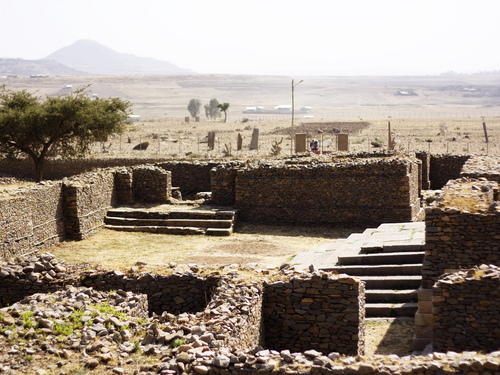
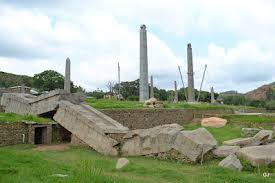
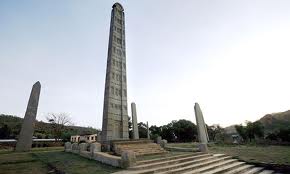
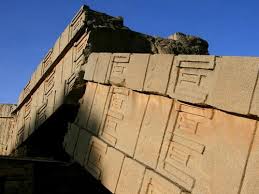
WHAT IS IT: Ethiopia`s holiest city
WHY IS IT IMPORTANT: Christianity was declared the national religion here in the fourth century
WHAT IS THERE TO SEE: One of the possible resting places of the Ark of the Convent,in which the Ten Commandments are held
WHERE IS IT: In north-eastern Ethiopia on the horn of Africa